I’ve been wanting to start a daily routine of doing three-figure readings for general well-being, largely inspired by some of the Tarot and rune practitioners in the online multi-tradition divination group I recently joined. After a few weeks of pondering and consulting with others, I finally arrived at an interpretative framework that I feel will work well for this purpose, more so than the past-present-future approach prescribed by John Michael Greer to interpret the Court and Four Triplicities in the traditional shield chart.1
For starters, casting a triad merely entails that you construct two figures using any hands-on method of randomly generating binary values (e.g., dice, stick-and-surface, coin, etc.), then use geomantic addition to produce the third figure. Those entirely new to geomancy are encouraged to read Part I and Section 2.2 of the FNG for an overview of the figures, their construction, and geomantic addition.
While it took me some time to develop a query that captures the type of insight I’d like the triads to convey, I eventually settled on the formulation: “What should I do, keep in mind, or try to feel to improve my overall well-being today?” Subsequently, I developed the following interpretative framework:

- 3rd figure – the main action to be taken, whether that’s something you do, call to mind, or try to feel.
- 1st figure – the person, place, or thing that the main action should involve or be directed towards.
- 2nd figure – the primary challenge to the main action you need to take, i.e., something that’ll make the main action difficult to accomplish.
Three examples are provided below to demonstrate how I’ve been interpreting these triads thus far using this framework. However, practitioners experimenting with this system are free to express or present their interpretations differently.
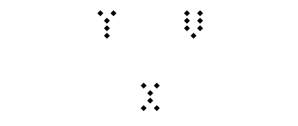
Tristitia, Caput Draconis, Conjunctio: Connect with someone around the topic of sorrow or ill health; the recent beginning of something, or a new opportunity in your life or theirs, will make this interaction challenging.

Amissio, Rubeus, Cauda Draconis: Stop wasting or depleting something; your vices and overindulgences will make this a challenging endeavor.
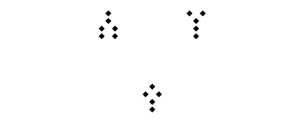
Caput Draconis, Fortuna Minor, Puella: Love and care for something just beginning in your life; the short-term support you’re now giving or receiving from somewhere/someone will make this difficult in some way.
In these examples, I’m interpreting the figures with relatively little inference—as though I were conducting a blind reading for someone else—primarily to demonstrate a conservative approach to deciphering triads in this context. I should note, however, that in several readings I’ve done for myself, I immediately recognized which aspect of my life the triad seemed to be addressing, which necessitated a more personalized interpretation.
Please feel free to share your experiences with this practice in the comments section below, as I’m eager to see how it performs in the hands of others.
Note
- John Michael Greer, The Art and Practice of Geomancy: Divination, Magic, and Earth Wisdom of the Renaissance (Newburyport: Weiser Books, 2009), 96–99.


First of all, thank you for your contribution. I’ve been using FNG for quite a few things, and your system has really proven to be very robust and quite resistant to different kinds of issues and errors.
I already thought your system was particularly well suited to more direct questions, quicker questions, rather than casting a full chart. Basically, yes-or-no questions, something much faster than laying out a complete geomantic chart.
For a while now, I’ve also been flirting with the idea of using three figures for more general readings, mood readings, getting a sense of the overall atmosphere or situation, something even quicker. More like reading a situation, or rather, reading the dynamics of a situation.
What I was missing, though, was precisely the tension you’ve created between Figure 1, Figure 2, and Figure 3. In fact, past, present, and future, or subject, object, and outcome, or thesis, antithesis, and synthesis, didn’t quite provide the dimension I felt was necessary for the whole thing.
And now you’ve brought that in.
So I’m going to use your technique not only for daily readings, but also for situation readings. And I’ll keep bringing you my results and feedback as I work with it.
LikeLiked by 1 person
Very much appreciated! I’m really glad you’re enjoying the FNG system, and I look forward to hearing about your experiences with this particular framework, especially as applied to situation readings.
LikeLike
Since you asked for feedback on how I’ve been using FNG, I wanted to share something recent that I think is particularly important about your system: the system of directions based on the geomantic figures, and the system of timing, also derived from the figures.
Recently, someone asked me to help locate her cat, which had gone missing, and I cast two charts using your system, one for timing and another for direction. And, in fact, both of them turned out to be accurate.
There was also a recent interpretation you made when you were looking for an apartment, where you used Rubeus to translate the figure’s correspondence into the color red. That also turned out to be remarkably precise. I used that same interpretation in this case, and the cat was actually found in a house west of the place where the person was. The house had red walls, and, on top of that, the cat was found wearing a red collar, within the one-month timeframe that I had obtained.
So your system, particularly when it comes to directions and timing, has proved extremely useful to me.
I also used it on another occasion to help locate a pair of headphones that someone else had lost, and it was quite useful in that case as well.
In other words, your table of correspondences has been remarkably effective in my experience. I don’t know what system or source you based those directional and temporal correspondences on, but every single time I’ve used them so far, they’ve given me accurate results.
LikeLiked by 1 person
Oh, wow! Thank you so much for sharing these results. I’ve been wondering how those techniques are working out for other practitioners, and I’m also glad to hear those tables are helpful.
Regarding the compass, I wanted representation for both the cardinal and ordinal directions, so organizing the figures into pairs based on their shared qualities of movements and ruling elements just made the most sense. I then arranged the pairs around the compass in light of the figures’ conceptual meanings, but also in such a manner that aligned their ruling elements with the seasons I associate with the eight directions. As a result of this arrangement, the compass also depicts the clockwise cycle of the four seasons, allowing the pairs to simultaneously serve as indicators of time in certain readings.
The temporal correspondences I created were largely inspired by an older traditional method that I first discovered in a post on the Digital Ambler: https://digitalambler.com/2013/02/26/de-geomanteia-geomantically-calculating-time-so-slowly-for-those-who-wait/
Thanks again for the feedback. Much appreciated.
LikeLike
Thank you again! I also like to do daily readings, but have never used geomancy. I look forward to incorporating your methodology into my practice.
LikeLiked by 1 person
Much appreciated!
LikeLike