Back in March of this year, I began a series of experiments in an effort to ascertain the interpretive value of the geomantic tetractys presented in La Géomancie Magique by Robert Ambelain,1 which he claims is of Touareg origin, and which I first discovered in a blog post by Sam Block on The Digital Ambler:

It was this particular framework that inspired my development of the Novenary Chart, which I admittedly created in haste without having fully explored the divinatory potential of the tetractys. Regarding the construction and use of this chart, Ambelain states the following (p. 200):
⠀⠀One of our correspondents and friends, an officer in the Moroccan goumiers, (the same who procured for the members of the “G.E.O.M” their sumptuous finely-chiseled red copper almadels), transmits to us this curious process of geomantic interrogation, still in use among some desert nomads.
⠀⠀The geomancer (usually a woman) waits to perform this rite on Friday. After drawing on the sand a pentagram surmounting a crescent, the operator pronounces an invocation to the evening star, then strikes a blow in the center of the star.
⠀⠀Then, he draws underneath, still on the sand, an equilateral triangle, base up, and divides it into sixteen smaller triangles using four oblique lines and three horizontal lines. (Reminder of the female cult, yoni, Ishtar or Astarté).
⠀⠀This done, he throws the sixteen rows of ordinary points and forms the four “mothers”, which he places in the upper row of his triangle.
⠀⠀Then copulating each of the “mothers” with the next one, (the 1st and 2nd, 2nd and 3rd, 3rd and 4th), he draws three more figures which he places in the second row.
⠀⠀Then, coupling these three new figures together, he thus forms two new ones, which he places in the third row.
⠀⠀Finally copulating these last two he then obtains the one which constitutes for him the “Judgment”, but considered simply as a pure answer (yes or no, good or bad).
⠀⠀By coupling this “judgment” with the first “Mother”, he then details the answer.
Unfortunately, Ambelain’s description of the chart only provides us with the role of the 10th figure, which he says functions as a “Judge” to render a “yes/no” or “good/bad” answer to the query. From his description, we also know that adding the 10th figure to the 1st Mother is supposed to yield additional details, yet he offers no clues as to what types of details those would normally be, nor the positional meaning of the 1st Mother itself.
With only this information to work with, and recalling a 2012 study in the field of psychology demonstrating the problem-solving capabilities of the subconscious,2 I decided to approach this project somewhat differently than I normally would. In short, I believe that my subconscious already knows how to use the tetractys in the most effective manner, and also suspect that it is capable of communicating that system to me through the chart itself by way of meaningful patterns, my personal relation to and understanding of the figures, etc.
Assuming this theory to be accurate, I cast three charts within a 12-day period. The first was generated for the query “Is X attracted to Y?” (chart below on far left), the second for the query “Will I find another job by the end of this year?” (middle chart), and the third for the query “Are they aware of my inquiries into the matter?” (chart on far right). At the onset of each reading, I recited the query internally and additionally petitioned my psyche to show me how to use the tetractys in the most effective manner, i.e., in a manner that would yield pertinent and subtle insights into each of these matters.
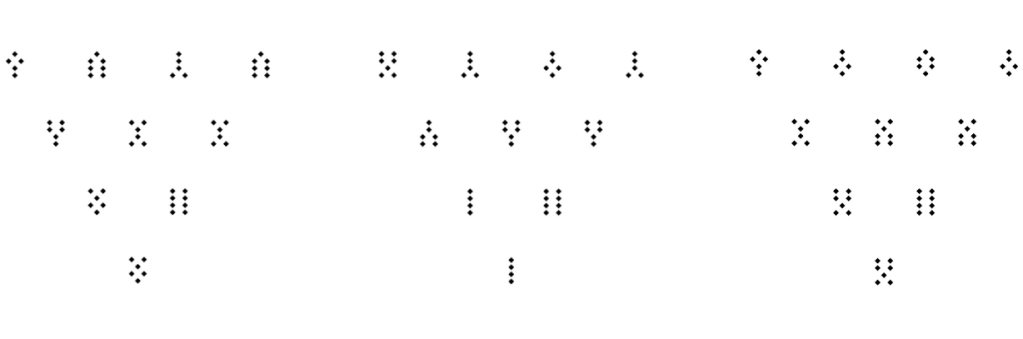
Well, I got some really interesting results. First, each of the charts contained figures that I felt were incredibly relevant to the queries. More importantly, after casting the second chart, I noticed that it contained a pattern that appeared in the first. In both charts, identical figures appear in the 1st and 3rd, 5th and 6th, and 9th and 10th pairs. Additionally, Populus appeared as the 8th figure in both charts.
Now, I was pretty sure this was only a coincidence that I was reading too much into, so I cast a third chart to rule out the possibility that the pattern was meaningful. However, upon completing the third chart, I was shocked to see that the pattern had repeated itself.
I’ve been studying these charts for nearly six months now and haven’t been able to figure out what is being communicated, so I’m sharing them here in the hope that someone will be able to crack this code. While this pattern could certainly be nothing at all, I strongly feel that it was not a coincidence, but rather my psyche’s attempt to communicate something about how I can use the tetractys, as I requested.
I interpreted the first two charts (far left and middle) as answering “yes” to both queries (based on the 10th figure and others within these charts), which turned out to be accurate. While I also interpreted the third chart (far right) as answering “yes”, I have yet to confirm this determination.
Any insights offered would be greatly appreciated and can be placed in the comments section of this post.
Footnotes
- Robert Ambelain, La géomancie magique (Paris: Éditions Adyar, 1940), 200–201.
- Tom Stafford, “Your Subconscious Is Smarter than You Might Think,” BBC, February 18, 2015, https://www.bbc.com/future/article/20150217-how-smart-is-your-subconscious; Asael Y. Sklar et al., “Reading and Doing Arithmetic Nonconsciously,” Proceedings of the National Academy of Sciences 109, no. 48 (November 27, 2012): 19614–19, https://doi.org/10.1073/pnas.1211645109.
 MINOR FRACTURE
10 and one added together gives you the reconciler in an ordinary chart. At a guess, this means that the Judge tells you if things will be good or bad or yes or no (depending on the question) and the reconciler will explain how this all comes about. So in your first chart x is attracted to Y (Aquistio is not bad it implies x wants to obtain y) . The reconciler is good for love but it is a very childish teen sexual attraction. It is not the sort of attraction you can build a long-term relationship on
LikeLiked by 1 person
Thank you, Nick, great points! Also, your interpretation of the reconciler (Puer) is a very accurate description of the type of attraction X has for Y, which I was later able to confirm. I appreciate your input as always.
LikeLike